How to Play Blackjack in New Zealand
 Available in US
From card totals and free play to live dealers, the guide explains how a round works and how player choices shape a hand.
Table of Contents
- The Deal, Card Values and the Aim of a Hand
- Player Decisions: Hit, Stand, Double Down or Split
- Blackjack Rules, Soft 17 and Payouts
- Learning the Game Through Free Play
- Online Blackjack: Software Games and Live Dealers
- Online Casino Rules and the New Zealand Licensing Transition
- Playing Blackjack with Other People
- Blackjack as a Game of Decisions, Not a Guaranteed System
- A Beginner’s Starting Point: What the Cards and Actions Mean
- Simulators, Betting and Playing More Than One Hand
The Deal, Card Values and the Aim of a Hand
Blackjack is a contest between each player’s hand and the dealer’s. The central aim is to finish with a total nearer to 21 than the dealer’s, without going over 21. The goal is not simply to collect as many cards as possible or to make a hand equal 21 at any cost: the value of the cards already held, and the dealer’s eventual total, determine how close a hand is to the target.
A hand total is calculated by adding the values of its cards. Number cards count at their printed values. A card showing a 4 contributes four points, while one showing a 9 contributes nine. Face cards—kings, queens and jacks—each count as 10. An ace is flexible: it may count as either 1 or 11. Those values are the basic arithmetic needed to follow a blackjack hand.
For instance, a 6 and an 8 make 14. A queen and a 5 make 15, because the queen contributes 10. The arithmetic does not change according to the card’s suit; the relevant information for this purpose is its rank and assigned value. Once each card has been counted, the hand’s total can be compared with the target of 21.
Choosing where to play blackjack in New Zealand starts with checking what is known about an operator, such as its listed licensing details or payout speed. Use this reference to see which specific details are available for each option.
License: Malta Gaming Authority, licence no. MGA/B2C/394/2017 N1 Casino lists a Malta Gaming Authority licence, number MGA/B2C/394/2017.
License: Tobique Gaming Commission, licence no. 0000002 Ricky Casino lists a Tobique Gaming Commission licence, number 0000002.
Payout speed: 1-3 business days Wintino lists a payout speed of 1–3 business days.
License: Malta Gaming Authority, licence no. MGA/B2C/370/2017 Play Grand lists a Malta Gaming Authority licence, number MGA/B2C/370/2017.
License: Tobique Gaming Commission, licence no. 0000091 7Bit Casino lists a Tobique Gaming Commission licence, number 0000091.
License: Curaçao Gaming Authority, licence no. OGL/2024/165/0185 BitStarz lists a Curaçao Gaming Authority licence, number OGL/2024/165/0185.
License: 07017519840 · Payout speed: 1-3 business days Zotabet lists licence number 07017519840 and a payout speed of 1–3 business days.
License: Tobique Gaming Commission, licence no. 0000064 Neospin lists a Tobique Gaming Commission licence, number 0000064.
Payout speed: 1-3 business days Lamabet lists a payout speed of 1–3 business days.
The ace requires a little more care because its value can change the total. With an ace and a 7, the hand can count as 8 or 18. The choice of value is not a separate action: it is a way of counting the cards so that the total reflects the ace’s stated flexibility. If another card makes the 11-point version exceed 21, counting the ace as 1 may keep the hand within the target. For example, an ace, a 7 and a 9 can be counted as 17: the ace contributes 1, rather than 11.
This flexibility means that a hand containing an ace cannot always be assessed by adding 11 automatically. The useful total is the one that follows the card values while avoiding a count above 21 when the ace can instead be treated as 1. In a hand without an ace, the total is more direct: the values of the cards are simply added together. In either case, the comparison remains the same—how the hand stands against 21 and against the dealer.
Going above 21 means that the hand has exceeded the target. A total below 21 remains in play for comparison, while a total of exactly 21 reaches the target without exceeding it. This distinction explains why a hand’s apparent strength depends on more than whether its cards look high individually. A high-value card can bring a total closer to 21, but the combined value of all the cards is what matters.
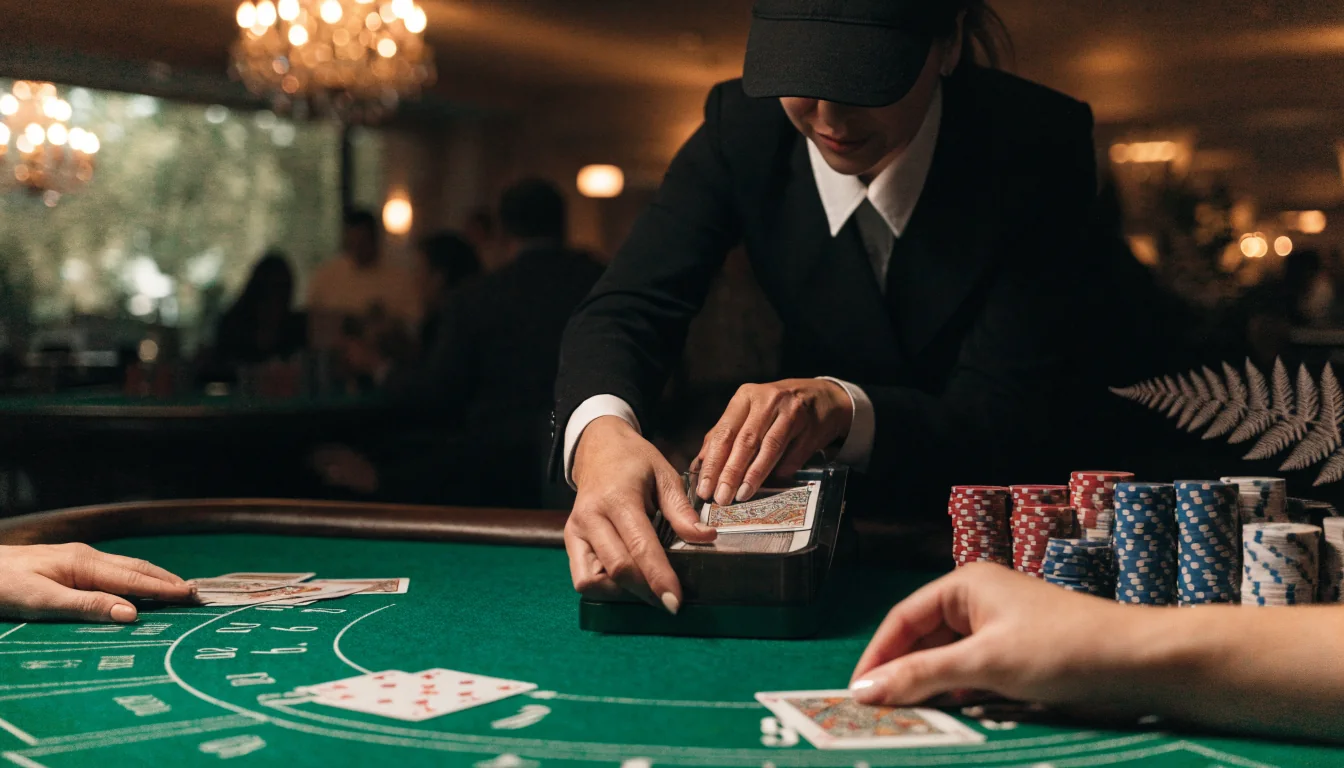
The dealer is the opponent in this comparison. A player’s total is not judged in isolation: it is assessed in relation to the dealer’s hand, with the aim of finishing closer to 21 without exceeding it. A total such as 18 may be near the target, but the objective still involves the dealer’s result. Conversely, a total below 21 is not automatically the closest possible outcome; the comparison depends on both hands.
This basic framework also explains why the value of a hand can be understood before considering any table-specific rules. The card arithmetic establishes what is currently held; the comparison with 21 establishes whether the total has exceeded the target; and the dealer’s hand provides the opposing result. The particular decisions available during play are a separate part of blackjack and do not alter the underlying values of the cards.
For someone learning how to play blackjack at a casino, recognising these values is the first practical step. A hand can be read by identifying each card, assigning its value, and adding the values together, taking account of an ace’s two possible counts. That process is the same whether the hand is being followed at a physical table or in an online game. The setting does not change the basic aim: finish closer to 21 than the dealer without going over.
Taking another card to potentially bring a hand closer to the target.
Taking no further cards and leaving the hand at its current total.
Changing the wager and committing to receiving exactly one more card.
Separating a pair of cards into two independent hands.
The phrase “blackjack 21” captures the target, but the game is not a race to reach that number regardless of the dealer’s hand. The object is comparative. The distinction matters because a total can be valid without being the winning total, while a total beyond 21 has gone past the game’s stated target. Understanding the deal therefore begins not with a prediction about what will come next, but with a clear reading of the cards already in the hand and the goal against which both hands are assessed.
Player Decisions: Hit, Stand, Double Down or Split
Once a hand is under way, the available actions shape how it develops. In blackjack, a player may hit, stand, double down or split, subject to the options allowed by the table. Each choice changes either the cards being taken or how the wager is applied; none guarantees a favourable result.
Hit means taking another card. It can bring a hand closer to the target, but it can also push the total beyond it. A hit is therefore a decision to accept another card’s effect rather than keep the hand as it stands. If the hand is already strong, the risk of taking too many cards may weigh against continuing; if it is weak, another card may offer a way to improve it.

Stand means taking no further cards. The hand remains at its current total, leaving the dealer’s result to determine how it fares. Standing avoids the possibility of exceeding the target through another card, but it also gives up the chance to improve the hand. The choice depends on the hand and the rules of the particular game, rather than on a fixed action that applies in every situation.
Double down changes the wager and commits the player to a more limited continuation of the hand. It can be considered when the prospect of one further card is appealing, but it also increases the stake exposed to the outcome. The details of when it is allowed, and what follows the action, depend on the game’s rules.
Split separates a pair into two hands, each played independently from that point. This creates another decision to manage and can change the total wager in play. Whether splitting is available, and how each resulting hand proceeds, is governed by the table rules.
These actions are not interchangeable. Hitting continues a hand, standing ends the player’s card-taking, doubling changes the wager and continuation, while splitting creates separate hands. A basic understanding of those distinctions makes blackjack play easier to follow without treating any single move as an automatic answer.
Blackjack Rules, Soft 17 and Payouts
Blackjack rules are not identical across tables. The number of decks, the dealer’s treatment of soft 17, surrender availability and the payout for a natural blackjack can all differ. A specialist review describes these as game-specific features, rather than fixed rules that apply everywhere. Since rule variations can affect both strategy and the house edge, the table conditions matter when comparing games.
Blackjack rules can vary by table, including the number of decks used and how the dealer handles a soft 17.
A soft 17 is a hand totalling 17 in which an ace counts as 11. The dealer may be required to hit it or to stand, depending on the table’s rule. That distinction can change how the dealer’s hand develops, so a strategy suited to one rule set may not be the best fit for another. The same applies to other rule differences: a strategy chart or general recommendation is only relevant when its assumptions match the game being played.
Natural-blackjack payouts also need to be read as a specific table condition. A natural is a blackjack made with the opening cards. A specialist review reports that such a hand may pay at a 3:2 ratio, while some tables offer 6:5. These are reported examples, not a dependable statement of what every New Zealand game offers. The ratio affects the return on a winning natural: 3:2 pays more than 6:5 for the same wager. A payout displayed in the game rules is therefore more useful than assuming a familiar rate.
The number of decks is another rule detail worth noting. It is not, by itself, enough to determine the best way to play blackjack: its effect sits alongside the dealer’s soft-17 rule, payout terms and other conditions. Surrender, where available, also changes the options provided by a table. These features should be considered together rather than treating one rule as a complete guide to the game.

For someone learning to play blackjack, the practical starting point is to identify the rules of the particular table before relying on a general strategy. A strategy can be sound under its stated assumptions yet unsuitable when the dealer’s soft-17 rule or payout differs. No single set of table rules can be inferred from the name “blackjack” alone. Comparing the displayed conditions gives a clearer basis for understanding how a variant differs and why a strategy may not transfer unchanged.
Learning the Game Through Free Play
Free play can provide a low-pressure way to become familiar with blackjack’s rhythm before any money is involved. Where a game offers a practice mode, it can show how a hand develops and how choices affect its progress. The purpose is orientation, not income: play for fun does not produce winnings that can be withdrawn, and results in a free session do not establish what will happen in later play.
A useful first step is to follow the cards rather than focus on a score alone. Number cards retain their face values, while face cards count as ten. An ace can be treated as one or eleven, depending on which value works for the hand. Watching how these values combine helps make the changing total easier to understand. It also clarifies why the same ace can matter differently as additional cards are dealt.
Practice can make the sequence of a hand less unfamiliar, but it should not be mistaken for proof that a particular approach will succeed. A short run of favourable results in a no-cost game is still a set of game outcomes, not evidence of a dependable pattern. Free play is most useful when treated as a way to observe the interface and understand what is happening, rather than as a test that predicts future results.
- Use free play to observe the game interface and rhythm.
- Follow the card values to understand how totals change.
- Mistake free play results as proof of a winning strategy.
- Assume free game rules are identical to paid tables.
The format of a free game is not necessarily identical to every paid table. Blackjack variants can use different rules, and those differences can affect how a hand proceeds and how decisions should be assessed. A practice session therefore offers information about the version being played, not a universal template for all blackjack. The displayed rules matter more than assumptions carried over from another game.
Some players look for a way to play blackjack for free without downloading software. That may be possible when a provider makes a browser-based game available, but the access method depends on the particular game. A free option should not be assumed to be available in every location or on every device. Similarly, sound controls and other interface features can differ; a game with audio may suit one setting, while muted play may be more practical in another. These are usability details, not indications of game quality or likely outcomes.

A free session can also help distinguish what is understood from what remains confusing. For instance, a player may recognise the values of the cards but still need time to follow how a total changes when an ace is involved. Pausing to observe the displayed hand and the game’s explanation can make that aspect clearer. Repeating the same situation may improve familiarity, although repetition does not alter the underlying uncertainty of later hands.
There is a limit to what practice can teach. Free play does not reproduce the emotional pressure of staking money, and comfort with a practice interface should not be taken as a reason to increase spending. It can reduce basic uncertainty about the presentation of a game, but it cannot guarantee accurate decisions or favourable results. Nor does a successful practice session establish that a strategy will work across tables with different rules.
When moving from free play to real-money gambling, the distinction between practice and wagering should remain clear. The relevant game rules and the fine print should be checked on trustworthy sites and casinos before play with money. Bonus terms may include wagering requirements, and blackjack may count differently towards them; maximum-bet rules can also apply during wagering. A budget set in advance can limit planned spending, while chasing losses can turn a recreational activity into escalating risk.
Free blackjack can be a sensible introduction when the aim is to understand the cards, follow a hand and become comfortable with a game’s presentation. Its value lies in familiarisation, not in creating an expectation of profit. The boundary is important: practice may make the mechanics more recognisable, but the result of a free session says nothing certain about the outcome of a later one.
Online Blackjack: Software Games and Live Dealers
Online blackjack is not a single format. A game may deal cards through software or show a live table using physical cards. The distinction affects how a round is presented and how quickly play can proceed; it does not change the basic aim of blackjack. Choosing between the formats is therefore a matter of understanding the experience each provides, rather than assuming that one is universally preferable.
Software vs Live Dealer
Software-based blackjack uses RNG to generate outcomes, allowing for a faster pace of play compared to live-dealer games which use physical cards and video streams.
Software play does not depend on a person dealing physical cards or a video stream, making the sequence of hands more direct and uninterrupted.
Software-based blackjack
In RNG blackjack, software shuffles the cards and generates the game’s outcomes. This format allows play to move faster than a live-dealer game, since rounds do not depend on a person dealing physical cards or on a video stream. The pace may suit a player who wants a more direct, uninterrupted sequence of hands. It also means that the cards are presented digitally rather than being dealt from a physical shoe on camera.
The term RNG describes the software-based format; it does not, by itself, explain every feature of a particular game. Rules can differ between blackjack variants, so the format should not be taken as evidence that all software games operate identically. The way a game handles its cards, its available options and its table conditions depends on that game. These details belong to the rules displayed for the individual table, not to the general label “RNG blackjack”.
A person looking to play blackjack online for free may encounter software games, but the format alone does not establish whether a particular game offers free access. Nor does “online” necessarily mean that a game can be played without downloading anything. Access conditions are specific to each platform and game. Where a free version is available, it can provide a way to view a software-driven hand without treating the experience as equivalent to a live table. The interface and pace may differ, and familiarity with the format should not be confused with evidence about real-money outcomes.
Software play can also make the difference in pace especially noticeable. The game does not need to wait for streamed footage of a dealer, so it can move through hands more quickly than the live alternative. That is a practical distinction, not a claim that faster play improves a player’s results. A faster sequence simply means that decisions and outcomes arrive with less interruption. The rate of play is part of the experience, and it may matter to someone comparing formats.
Live-dealer blackjack
Live-dealer blackjack uses actual cards, with the game shown through a video stream. Its presentation is closer to sitting at a casino table: physical cards are dealt rather than represented only by software. For someone who values seeing a real deal take place, that visual feature is the defining difference. It does not mean that every aspect of an in-person casino visit is reproduced online; the relevant similarity is the use of actual cards and a dealer at a table.
Streaming introduces practical trade-offs. Video can delay the game, so a live round may proceed more slowly than a software game. The delay is a feature of the streamed format, rather than a change to the underlying goal of blackjack. A live table may also require higher bets than a software game. Since that condition can matter to the choice of format, the table’s stated betting terms should be considered before play begins. No single minimum can be inferred for all live games.
Attention Live-dealer games may have higher minimum betting requirements than software-based versions.
A slower pace may be acceptable to someone who prefers a physical deal on screen, but it is not automatically an advantage. Conversely, the faster rhythm of software play is not inherently better. The relevant choice depends on whether the priority is a streamed, physical-card presentation or a quicker software-based sequence, alongside the conditions attached to the specific game. Neither format removes the need to understand the table rules.
Comparing the formats
The clearest comparison is between how cards are produced and how quickly a game can proceed. Software shuffles support faster play; live blackjack presents actual cards but depends on streaming, which may delay the action. The live format may also come with higher betting requirements. These are established differences between the formats, while other details need to be checked game by game.
Searches for free online blackjack or a blackjack game to play online can refer to several different experiences. A free game, where offered, may be software-based or may be part of a live presentation, but the phrase alone does not identify which. It also does not establish whether the game requires a download, what table rules apply, or whether any particular access condition is available. Those points cannot be assumed from the word “free”.
The choice between software and live play should therefore be based on the actual format and stated conditions, not on a general impression that all online blackjack works the same way. Software games offer a faster pace through digital shuffling; live-dealer games use real cards, with streaming delay and potentially higher betting requirements. That distinction is sufficient to orient a comparison without treating either format as a promise of a particular result.
Online Casino Rules and the New Zealand Licensing Transition
New Zealand’s rules for online casino gambling are changing from a system that prohibited domestic online casinos to one that provides for local licensing. The Gambling Act 2003 does not permit online casinos to be based in New Zealand. Before the new framework took effect, gambling websites operating from overseas were not licensed or supervised by a New Zealand regulator. Customers who wagered with those offshore services had no domestic government recourse.
The Online Casino Gambling Act 2026 came into force on 1 May 2026 and established the country’s first domestic licensing framework for online casino gaming. The Department of Internal Affairs (DIA) is New Zealand’s primary gambling regulator and oversees this online casino framework. The Gambling Commission has a distinct role: it hears and decides casino licensing applications, issues online casino licences, and approves changes to licence conditions. The Commission’s licensing decisions therefore sit within a framework overseen by the DIA.
The law also provides a transition period for services already operating in New Zealand. Online casinos that were serving people in the country before 1 May 2026 may continue during that transition, which ends on 1 December 2026. This does not mean that every offshore website has a New Zealand licence. The legal position during the transition is tied to the Act’s transitional provisions and to whether a provider was already operating in the market before the commencement date.
Licensing Transition
Unlicensed operation is expected to become an offence around mid-2027, with potential fines of up to NZ$5 million.
The full licensed regime is not expected to be operational until 2027. Providers that have not applied for a licence must stop conducting online casino gambling in New Zealand by 1 December 2026. If an application is declined, the provider must end its online casino operations in the country and leave the market. Unlicensed operation is expected to become an offence around mid-2027. Operators may face enforcement action and fines of up to NZ$5 million. Licensed providers will also have to implement stricter age and identity verification systems.
These changes matter when assessing where online blackjack is available. A site’s accessibility to people in New Zealand does not, by itself, establish that it holds a local licence. Nor should a general claim that a site is “regulated” be read as proof of New Zealand authorisation: regulation by an overseas body is not the same as a licence issued under the domestic framework. During the transition, advertising online casino gambling to people in New Zealand is prohibited. Once licensed, operators may advertise only under tight rules, and sponsorships are prohibited.
Questions about the best place to play blackjack online, including live games or bonuses, cannot be settled by a name or promotional claim alone. The licensing transition determines which providers may operate and under what authority; it does not establish that a particular site is suitable or that a bonus is favourable. Bonus conditions can also affect play, so claims about professional play or casino blackjack bonuses should not be treated as evidence of licensing status. The regulatory distinction is between the provider’s position under New Zealand law and the separate terms attached to a game or promotion.
Playing Blackjack with Other People
Blackjack remains a contest against the dealer, even when several people are present at a table. Each player’s aim is to finish closer to 21 than the dealer without going over. Other players are therefore not opponents in the same sense as the dealer: their hands do not replace the dealer as the comparison that determines the result.
This distinction helps clarify what it means to play with two people. The phrase may describe two players taking part in the same setting, but it does not by itself explain how a particular game handles seats, hands or interaction. A two-person arrangement could also mean one player and a dealer, rather than two players competing against each other. The game’s basic objective stays focused on the dealer.
Online, “playing with other players” can refer to a shared table or simply to a game in which other participants are present. Those descriptions are not interchangeable. The presence of other people does not establish that players can influence one another’s hands, communicate, or form teams. Nor does it change the central comparison between each player and the dealer. Claims about a social or cooperative format need to be understood as claims about the specific game, not as a different definition of blackjack.
The same separation applies to card counting software. Counting is a way of tracking cards, not a multiplayer format, and the term does not indicate that another person is involved. Software may be discussed in connection with counting, but that alone says nothing about whether a game includes shared play or whether a tool can improve the outcome. In online blackjack, the game format matters: RNG games use software shuffles, while live-dealer games use physical cards. No general conclusion about software-assisted counting follows simply from those distinctions.
Core Objective
Blackjack is a contest where the aim is to finish closer to 21 than the dealer without going over.
For anyone comparing descriptions of online games, the useful question is what “with other players” means in that particular context. A table may be presented as shared, but that label alone does not establish the rules of participation or the extent of interaction. The reliable point is narrower: blackjack is played against the dealer, and the presence of other participants does not alter that underlying structure.
Blackjack as a Game of Decisions, Not a Guaranteed System
Blackjack strategy is conditional: a decision that fits one version of the game may not fit another. Variants can change rules in ways that affect both the choices available and the house edge. A strategy claim therefore needs to identify the rules it assumes; without that context, it cannot be treated as a reliable guide to every blackjack game.
This also limits what a system can promise. A sequence of bets or a fixed approach to decisions cannot guarantee a winning result. Blackjack outcomes remain uncertain, and a method that describes when to act is not a promise about what the next hand will produce. Claims of a guaranteed system go beyond what rule-based strategy can establish.
The distinction matters whether blackjack is played casually or for money. In a simple game, a consistent approach can make decisions easier to follow, but consistency alone does not remove the effect of differing rules or make results predictable. In a real-money game, those distinctions should be considered alongside the table’s stated conditions. Fine print and bonus terms warrant careful review on trustworthy casino sites before play. Blackjack may count differently towards wagering requirements, and maximum-bet rules can apply while those requirements are active.
A measured approach also separates decisions from staking claims. Setting a budget in advance and avoiding attempts to recover losses by increasing play helps keep spending within a defined limit; neither practice changes the game’s underlying odds. A betting pattern should not be presented as a way to overcome them.
The practical value of strategy is narrower but still meaningful: it provides a framework for making choices under particular rules. It does not convert blackjack into a predictable sequence or make a winning outcome certain. Any claim about a method is strongest when it states the game conditions to which it applies and avoids extending that conclusion to other variants.
A Beginner’s Starting Point: What the Cards and Actions Mean
A beginner can follow a blackjack hand by recognising three things: the value of the cards, the running hand total, and the actions available when it is their turn. The game is played against the dealer. The aim is to finish closer to 21 than the dealer without going over that total.
Calculating Card Totals
Recognise each card in the hand, such as a 6, an 8, or a Queen.
Assign values where number cards count at face value, face cards count as 10, and an ace can be 1 or 11.
Sum the values together to find the total, such as a 6 and an 8 making 14.
Number cards count as the number shown. A jack, queen or king is worth 10, while an ace can count as either 1 or 11. The ace’s flexibility means the same hand can have more than one useful total. For instance, an ace with a six can count as seven or seventeen, depending on what is more suitable as the hand develops.
The main actions are hit, stand, double down and split. Hitting adds a card to the hand; standing ends the player’s turn without taking another card. Doubling down and splitting are also available actions, though they change how a hand is played. The choices are distinct, so recognising their names is a basic part of following a round. Their availability and conditions depend on the game’s rules.
A new player does not need to memorise every possible situation to understand the flow of a hand. It is enough at first to identify the cards, calculate the total, and know which action has been selected. As cards are dealt, the total may change; the player’s choice then determines whether another card is taken or the hand is left as it stands.
What is needed to play, in practical terms, is access to a blackjack game and an understanding of these card values and action labels. The details of a particular table can affect how the available choices work, so its rules matter before play begins. Where real money is involved, setting a budget in advance and not chasing losses are important safeguards. Bonus terms should also be read carefully: blackjack may count differently towards wagering requirements, and maximum-bet conditions can apply while those requirements are being met.
This basic orientation makes a hand easier to read without treating any choice as a guaranteed route to a favourable result. Blackjack remains a game in which the cards dealt and the rules in force shape the outcome.
Simulators, Betting and Playing More Than One Hand
A blackjack simulator can make the sequence of decisions easier to follow by letting a player consider what to do at different points in a hand. The relevant choices include taking another card, keeping the current total, doubling the wager under the game’s rules, or splitting a pair. The value of a simulator lies in practising recognition of these options, not in proving that a particular choice will produce a win.
Results from simulated hands should be read cautiously. A run of favourable outcomes does not establish that the same pattern will continue, and repeated play does not turn chance into a reliable prediction. A simulator is most useful when its rules are understood and its outcomes are treated as illustrations rather than forecasts.
Rules can differ between blackjack games. A specialist review notes that variations may include the number of decks, how the dealer plays a soft 17, whether surrender is available, and the payout for a natural blackjack. These differences matter when interpreting a simulated hand: a choice modelled under one set of rules may not apply to another. The game’s stated rules should therefore be considered alongside any practice, rather than assuming that all simulations represent the same table.
Playing two hands at once is a separate format question from deciding how to play an individual hand. The same basic actions may arise, but the presence of more than one hand should not be treated as evidence that a simulator models every table’s arrangement or rules. Where a simulator does not clearly explain its setup, its results have limited value as a guide to a different game.
Betting also requires a distinction between practice and real-money play. A simulated wager does not establish what a real table permits or how a promotion treats blackjack. Wagering requirements may count blackjack differently from other games, and maximum-bet rules may apply while those requirements are being met. Any real-money play should be kept within a set budget, with losses not chased. Insurance should not be treated as a routine wager for most players.
Published by the Casino Slots Adviser NZ team.