Free Blackjack in New Zealand: Rules and Play
 Available in US
A practical guide to scoring hands, making key decisions and comparing free-play formats and table conditions.
Table of Contents
- How Blackjack Hands Are Scored and Played
- Free Play and the Main Blackjack Decisions
- What a Blackjack Payout Means in Free Play
- Playing for Fun: Online and Live-Dealer Formats
- Free Online Blackjack in New Zealand: The 2026 Licensing Context
- Browser Play, Downloads, and Registration
- Using a Blackjack Simulator to Compare Rules
- Free Play, Deposits, and Table Conditions
- Practice, Strategy, and the Limits of Card Counting
- Unblocked Blackjack and What the Rules Still Require
How Blackjack Hands Are Scored and Played
Blackjack is a contest between each player’s hand and the dealer’s. The aim is to finish with a total closer to 21 than the dealer’s, without going over 21. The hand’s value is calculated by adding the values of its cards. A total above 21 exceeds the limit, so a hand’s strength depends not only on how high its current total is but also on whether another card could take it past that point.
Number cards count as the numbers shown on them. A card marked 2 contributes two points, while a card marked 9 contributes nine. The face cards—jack, queen and king—each count as 10. Their rank does not change their value in the hand: a jack and a king contribute the same amount. The ace is different because it can count as either 1 or 11.
This range of card values provides the basic arithmetic for a free blackjack game, whether it is played with physical cards or through an online interface. A hand is not scored by the number of cards it contains or by their printed rank alone. Instead, each card’s blackjack value contributes to the running total, with the ace interpreted in the way that best fits the hand without taking it over 21.
For instance, an ace and a 7 can be counted as 18 if the ace is valued at 11. If the hand later receives a card that would make that total exceed 21, the ace can instead count as 1. The hand then totals 9 plus the value of the new card, rather than automatically busting because the ace was first counted as 11. The ace’s flexible value is therefore part of the scoring rule, not a separate bonus.
A hand containing an ace counted as 11 is often described as a soft total. It is soft because the ace can shift to a value of 1 if necessary, changing the total without exceeding 21. A hand in which the ace must count as 1 to keep the total within the limit is hard. The distinction describes how the total is formed; it does not alter the face values of the other cards. Hands with no ace are also scored by adding the values of their cards.
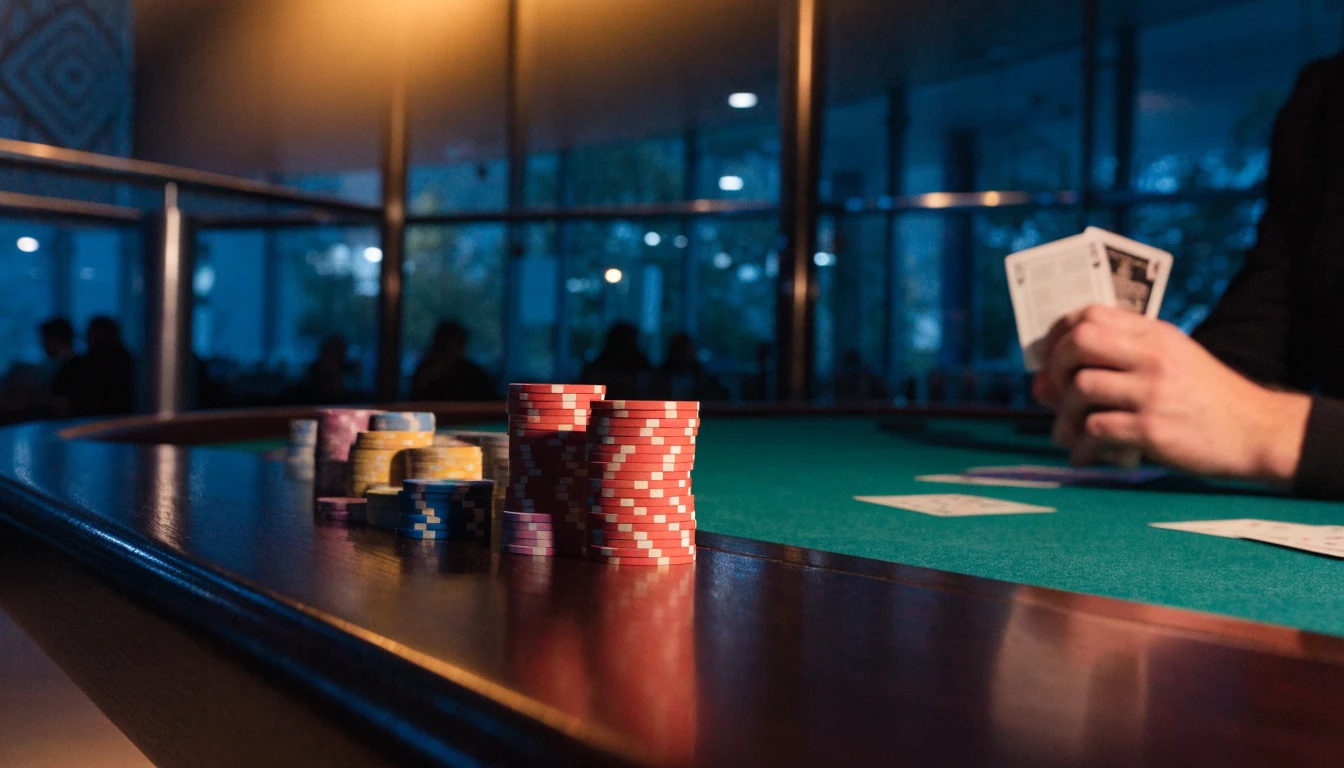
Consider a hand with an ace and a 6. Its total can be 17 or 7, depending on how the ace is counted. If another card is added, the total can be recalculated using the ace as 1 where that prevents the hand from exceeding 21. By contrast, a hand made up of a 10 and an 8 totals 18, with no flexible card to reduce the sum. These examples show why the visible total may not tell the whole story when an ace is present.
The comparison with the dealer gives the total its purpose. A hand that reaches 21 or comes close to it is not assessed in isolation: the dealer’s hand matters too. A player can remain below 21 and still fail to finish closer to that target than the dealer. Conversely, the objective is not simply to collect cards until 21 is reached; exceeding 21 defeats the purpose of building a strong total. The same scoring principle applies across casino blackjack games, including free versions.
Blackjack hands may involve decisions such as taking another card, keeping the current total, doubling down or splitting a pair. Those options do not change the underlying card values. Whatever action is taken, the hand is still assessed by adding its cards under the same scoring framework, with an ace available as 1 or 11. The particular choices available can depend on the game’s rules, so the mechanics of scoring should be kept distinct from the decisions made during a hand.
For someone learning through a free blackjack card game, the most useful starting point is to follow the arithmetic as each card appears: identify its value, add it to the hand, and reconsider any ace. This makes it easier to see why identical-looking totals can carry different implications. A hard total cannot be adjusted through an ace, while a soft total may have room to change if the hand receives another card.
The essential rule is straightforward: number cards retain their face values, face cards count as 10, and an ace can be 1 or 11. Those values produce a hand total, which is then compared with the dealer’s. The aim remains to be closer to 21 without exceeding it. These principles provide the foundation for understanding a blackjack hand before considering the choices that arise as play continues.
Card Values Number cards = face value, Face cards = 10, Ace = 1 or 11
Objective Get a total closer to 21 than the dealer without exceeding it
Hand Types Soft total (contains an ace counted as 11) or Hard total
Free Play and the Main Blackjack Decisions
A free-play hand still turns on choices made while cards are in play. After receiving a hand, a player can take another card, keep the current total, increase the stake through a double down, or divide a pair by splitting. Surrender may also be available. Which choices a particular hand permits depends on the table’s rules, so the controls and their conditions should be read before play begins.
Hit or stand
A hit requests another card. It can improve a hand that is low, but it can also take the total above 21, ending the hand as a bust. The choice therefore involves a trade-off: a further card may bring the hand closer to a competitive total, while the existing total may already be preferable to risking another card.
Standing means taking no further cards. The hand remains at its current total, and play proceeds according to the game’s sequence. It is not a way to guarantee a favourable result: the dealer’s hand still determines whether the player’s total wins, loses or ties. A decision to stand can be understood as accepting the current hand rather than exposing it to another card.
The interface may present these options as buttons, but the labels are more important than their appearance. A hit changes the hand; a stand ends the player’s turn. In free play, making the choice slowly enough to understand its effect can help distinguish the decision itself from the outcome that follows. A hand that wins after a hit does not prove that hitting was always appropriate, just as a loss after standing does not establish that standing was a mistake.

Double down
Double down is a decision to increase the stake on the hand while taking a more restricted course of play. It is different from simply hitting, because it changes the stake as well as the way the hand continues. The exact conditions attached to this option are set by the table, so the game’s displayed rules matter before the selection is made.
In a free-play setting, the choice can still be useful to observe even when no cash is at stake. It shows how a game handles a decision that combines a change in stake with a commitment to the hand’s next stage. The result can be favourable or unfavourable; the button does not make the hand safer, and it is not a system for controlling the outcome.
If a table provides a confirmation step, its wording should be read rather than treated as a routine prompt. Once double down is selected, the hand may offer fewer subsequent choices than it would after an ordinary hit. The important distinction is between taking another card while keeping the existing decision open and committing to the table’s double-down procedure.
Split
A split applies when the hand and table rules allow a pair to be divided into separate hands. Instead of continuing with the original pair as one hand, the player treats the cards as the beginnings of two hands. Each then has its own result against the dealer. This creates more than one outcome to follow, rather than improving a single hand in isolation.
Request another card to improve a low total.
Take no further cards and keep the current total.
Increase the stake while taking a more restricted course of play.
Divide a pair into two separate hands.
The option can make the round harder to track, especially when the game displays multiple hands in sequence. Each hand should be considered separately as its turn arrives. A choice made for one does not automatically settle the other, and the available actions may depend on the rules in force. Free play offers a way to see how the interface records separate hands without confusing a split with an ordinary hit.
Splitting is not inherently advantageous simply because it creates another hand. It changes the structure of the round and may involve additional stake according to the game’s procedure. The table rules determine how the split is handled; the label alone does not describe every condition. The relevant practical question is what the game will do after the selection, including what choices remain for each resulting hand.
Surrender
Some tables offer surrender, allowing a player to give up the hand rather than continue it. This is distinct from standing: standing keeps the hand active, whereas surrender ends the player’s participation in that hand under the table’s rule. It is also distinct from a hit, which adds a card, and from a split, which creates separate hands.
Because surrender is not available at every table, its presence should not be assumed from one game to another. Where it appears, the terms shown by the game determine how the choice is applied. The action is best understood as an exit from the current hand, not as a way to alter the cards or improve the hand’s total.

Free play makes it possible to become familiar with how these decisions are presented and what follows each selection. It does not remove the need to distinguish the options: hit changes the hand with another card; stand keeps the current hand; double down changes the stake and limits the continuation; split separates a pair into hands; and surrender ends a hand where permitted. The rules displayed for the particular table govern which actions are available and how they operate.
What a Blackjack Payout Means in Free Play
A payout describes how a winning hand is credited under a table’s rules. In free play, that figure is part of the game’s scoring rather than a cash return: credits shown on screen are used to represent the result of a hand, not money won from a wager. The distinction matters because the same payout label can appear in a real-money game and a practice game while having different practical consequences.
A specialist review reports that a natural blackjack may be paid at a ratio of 3:2, while some tables instead use 6:5. These are two different rule settings, not fixed terms that can be assumed to apply to every game. The ratio describes the return attached to a qualifying natural blackjack relative to the stake in a money game. In a free-play version, it indicates how the game calculates the corresponding credit result. It does not turn those credits into a cash prize.
The difference between the ratios is meaningful even though both are presented as winning payouts. Under a 3:2 rule, the credited return is greater than under a 6:5 rule for the same stake or equivalent free-play credit. A table’s displayed payout rule therefore affects how a particular winning hand is recorded. The label “blackjack” alone does not establish which ratio applies; the game’s paytable or rules should be read for that detail.
In free play, payout ratios like 3:2 or 6:5 represent how credits are calculated rather than cash returns.
The term “free bet” can also be ambiguous. In casual descriptions, it may refer to playing blackjack without staking money, while in other contexts it can describe a promotional offer. Those meanings should not be treated as interchangeable. A free-play table is a practice format in which the result is recorded within the game. The phrase does not, by itself, establish that a promotion is available, that a real-money stake is covered, or that a result can be withdrawn.
This distinction also limits what can be inferred from a displayed free-play balance. A balance may rise after a winning hand according to the table’s payout setting, but the figure remains a game record unless the format explicitly involves real-money wagering. A result shown as a win does not necessarily represent a prize, and a payout ratio does not describe the value of free credits outside the game.
The payout ratio alone is not a complete measure of a game’s return or quality. It applies to a particular hand outcome; other rules and possible results also shape the overall mathematics of blackjack. Consequently, a free-play result can help show how a table applies its stated payout, but it cannot establish the expected return of every game carrying the same name. A label such as “free bet blackjack” is not enough to identify the rules or financial status of a game.
For a comparison between free-play tables, the useful detail is the stated natural-blackjack payout and whether the game is clearly presented as practice play. A 3:2 or 6:5 display explains how that outcome is scored; neither figure means that free-play credits are redeemable. The payout rule and the status of the balance are separate parts of the game description.

Playing for Fun: Online and Live-Dealer Formats
Free blackjack online can be presented through software-based games or through a live-dealer stream. Both reproduce a blackjack table, but the way cards are dealt and the pace of play differ. These distinctions shape the experience of playing for fun, even when no cash wager is involved.
In an RNG game, software shuffles and deals the cards. The process does not depend on a streamed dealer handling a physical deck, so hands can be played more quickly than in a live-dealer game. This makes software-based blackjack suitable for short, uninterrupted sessions or for trying out a game at a self-directed pace. The faster rhythm is a feature of the format, not evidence that outcomes are more favourable.
A live-dealer game uses actual cards dealt at a table and shown through a video stream. Its visual format is closer to being seated at a casino table: the dealing is performed in real time rather than generated as a software animation. That can make the sequence of play easier to follow as a physical event. However, the stream may introduce delays, and live tables may require higher bets than software games. Those features can affect whether a live table suits a particular free-play purpose; the format alone does not establish that a free version is available.
The distinction also matters when the aim is simply to explore an online blackjack game without treating it as a cash activity. A software game offers a more rapid sequence of hands, while a live game gives the dealing a physical, streamed presentation. Neither description, by itself, indicates what happens to any balance or whether a particular table can be used without depositing. The availability and conditions of free play depend on the specific game and service.
Software vs Live Dealer
In an RNG game, software shuffles and deals the cards, allowing for a faster rhythm. A live-dealer game uses actual cards dealt at a table shown through a video stream, providing a physical, real-time experience.
Searches for free multiplayer blackjack can refer to a social style of play, but the label does not establish how a particular game operates. A live-dealer table is not necessarily a multiplayer game in the sense of players competing against one another; its defining feature here is the use of a dealer and actual cards. Likewise, a software game’s faster pace does not show whether other players are present. The format should be judged by its dealing method, rather than by assumptions drawn from terms such as “multiplayer.”
For a casual session, the practical comparison is therefore between speed and presentation. RNG blackjack uses software shuffles and moves faster. Live-dealer blackjack shows actual cards, but streaming can slow the experience and the table may involve higher bets. These are differences in how a game is delivered, not separate blackjack objectives. Free blackjack games for fun can belong to either format where offered, but the format label alone is not proof that a no-cost version exists.
Free Online Blackjack in New Zealand: The 2026 Licensing Context
Free-play blackjack lets you explore the game without risking real money. This list gives you a concise reference to the available operator information as you choose where to play in New Zealand.
License: Malta Gaming Authority, licence no. MGA/B2C/394/2017 N1 Casino is listed with a Malta Gaming Authority licence, number MGA/B2C/394/2017.
License: Tobique Gaming Commission, licence no. 0000002 Ricky Casino is listed with a Tobique Gaming Commission licence, number 0000002.
Payout speed: 1-3 business days Wintino is listed with a payout speed of 1–3 business days.
License: Malta Gaming Authority, licence no. MGA/B2C/370/2017 Play Grand is listed with a Malta Gaming Authority licence, number MGA/B2C/370/2017.
License: Tobique Gaming Commission, licence no. 0000091 7Bit Casino is listed with a Tobique Gaming Commission licence, number 0000091.
License: Curaçao Gaming Authority, licence no. OGL/2024/165/0185 BitStarz is listed with a Curaçao Gaming Authority licence, number OGL/2024/165/0185.
License: 07017519840 · Payout speed: 1-3 business days Zotabet is listed with licence number 07017519840 and a payout speed of 1–3 business days.
License: Tobique Gaming Commission, licence no. 0000064 Neospin is listed with a Tobique Gaming Commission licence, number 0000064.
Payout speed: 1-3 business days Lamabet is listed with a payout speed of 1–3 business days.
Free online blackjack sits within a changing regulatory environment in New Zealand. The Online Casino Gambling Act 2026 came into force on 1 May 2026, establishing the country’s first domestic licensing framework for online casino gambling. That framework does not, by itself, establish whether a particular website is licensed or whether its free-play games are covered by a specific licence.
The Department of Internal Affairs (DIA) is New Zealand’s primary gambling regulator and oversees the online casino licensing framework. The Gambling Commission has a distinct role within that system: it hears and decides casino licence applications, issues online casino licences and approves changes to licence conditions. These responsibilities concern the regulatory framework, rather than the rules or operation of a blackjack hand.
The transition period
The Act provides a transition from 1 May 2026 to 1 December 2026. During this period, providers that were already offering online casino services in New Zealand before the Act commenced may continue operating, subject to the Act’s transitional provisions. The full licensed regime is not expected to be operational until 2027. Providers that have not applied for a licence must stop conducting online casino gambling in New Zealand by 1 December 2026. Unlicensed operation is expected to become an offence around mid-2027.

These dates describe changes to the legal framework; they do not confirm a site’s application status, eligibility or licence outcome. Nor does the presence of a free blackjack option establish that the provider holds a New Zealand licence. A game’s free-play setting and the provider’s regulatory position are separate questions.
Before the 2026 Act, online casino gambling offered from outside New Zealand was not licensed or supervised by a New Zealand regulator. A customer who wagered through an offshore website during that period had no domestic government recourse. The new law creates a domestic licensing route, but the transition means that the regulatory position depends on the relevant provider and the stage of the framework.
What the regulators’ roles mean
The DIA’s oversight and the Commission’s licensing functions should not be conflated. The DIA is responsible for the broader regulation of gambling and oversight of the licensing framework. The Commission determines applications and manages licences, including approving changes to their conditions. A claim that a site is “regulated” or “licensed” therefore needs to be tied to its actual status under the applicable framework, rather than inferred from a game being available in New Zealand.
Attention A free-play label describes a mode of play and does not independently verify a provider’s legal status or licensing.
This distinction matters for free casino blackjack as well as for games involving wagers. A free-play label describes a mode of play; it does not independently verify a provider’s legal status. The regulatory bodies named above have defined functions, but those functions do not supply evidence about any particular service. No conclusion about an individual site’s licence can be drawn solely from the availability of blackjack online, whether free or otherwise.
Browser Play, Downloads, and Registration
Free blackjack may be described in terms of how the game is accessed: through a browser, through downloaded software, or after creating an account. These are separate features. A browser-based game does not, by that fact alone, establish whether registration is required; likewise, a downloadable game may or may not involve an account. Availability depends on the service and its conditions.
In an online RNG game, software shuffles the cards. The game is therefore run by the software rather than by a physical deck handled at a table. This describes how the cards are generated, not whether the game opens directly in a browser, requires an installation, or can be played without registering. Those access details need to be established for the particular game.
A browser option generally means the game is accessed through a web page rather than by installing a separate application. That can reduce the need to manage an additional program, but it does not establish that the game is available without an account or that every device will support it. Nor does the word “free” settle those points: it describes the play mode, not necessarily the steps required to reach it.

Downloaded software is a different access route. It may involve installing a program before play, while a browser version may run within the browser. The presence of a download does not, by itself, show whether the game is free or whether account registration is necessary. Similarly, a game that requires no download may still have other access conditions.
Registration is another distinct question. Creating an account can be required independently of whether a game is browser-based or downloaded. A label suggesting that no account is needed should therefore be read as a claim about registration only; it does not describe the shuffle method or confirm the full conditions of access.
The available distinctions support a careful reading of these descriptions, rather than a general claim that free blackjack is always playable instantly, without installation, or without registration. For a particular game, access requirements must be checked separately from whether it uses software shuffles.
Using a Blackjack Simulator to Compare Rules
A free blackjack simulator can be used to examine how a game’s rules shape play, rather than simply to rehearse the sequence of a hand. Blackjack variants do not all follow identical rules, and those differences can affect both strategy and the house edge. A simulator therefore offers a way to compare game conditions without treating one set of rules as universal.
Where a simulator allows rule settings to be changed, comparisons are clearest when one setting is altered at a time and the rest are held constant. This makes it easier to see which difference corresponds with a change in the available choices or the game’s results. If several settings change together, it becomes harder to identify what influenced the comparison.
Simulator Use
A simulator is a tool for observing how rule variations change decisions, not a predictor of future outcomes.
The exercise is not a prediction of future hands. A run of simulated play shows outcomes under the selected conditions; it does not establish that the same pattern will continue. Nor does a favourable short-term result demonstrate that a strategy has overcome the house edge. The value lies in observing how a rule variation can change the decisions that appear appropriate, and in separating that effect from the randomness of individual hands.
A useful comparison can focus on whether a strategic choice remains the same under different rule sets or whether the preferred response changes. The simulator can also help make the distinction between a rule’s effect on strategy and its effect on the house edge. These are related, but not identical: a change may alter the player’s decision process, the game’s mathematical balance, or both.
Free blackjack play in a simulator is consequently best treated as a controlled learning exercise. It can clarify the relationship between rules and decisions, but the conclusions apply only to the conditions represented in that simulation. Results should not be transferred automatically to another blackjack game, since its rules may differ. When settings are not explained or cannot be inspected, the simulator provides less basis for a meaningful comparison.
Free Play, Deposits, and Table Conditions
The word “free” does not, by itself, describe every condition attached to a blackjack game. It may refer to playing without staking cash during a hand, but that does not establish whether access requires an account or a deposit. Those are separate terms. A free-play label is therefore not enough to determine whether a no-deposit option is available, or what conditions apply to it.

Table rules also differ. A specialist review reports variation in deck count, whether the dealer hits or stands on soft 17, surrender availability and blackjack payouts. These details should be checked for the particular table rather than assumed to be shared across games. The review supports the point that conditions can vary; it does not establish the rules of every free-play game.
Deck count and the dealer’s soft-17 rule describe how a table operates, while surrender and payout terms set other conditions of a hand. Such differences can matter when comparing games, even where no cash is staked. A free-play mode does not necessarily reproduce the conditions of another table, and a familiar game name alone does not confirm that the rules match.
Deposit terms belong to a different comparison. Whether a game can be opened without depositing money cannot be inferred from its table rules or from the word “free.” The same distinction applies to games accessed in a browser: access method does not establish whether a deposit is required. Terms should be read carefully before any real-money play, including bonus conditions on trustworthy sites and casino services. Blackjack may count differently toward wagering requirements, and maximum-bet rules can apply while wagering conditions are in force.
A practical comparison therefore separates two questions: what rules govern the hand, and what conditions govern access or any associated offer. For real-money play, setting a budget and avoiding attempts to recover losses helps keep those decisions distinct. Free play can show how a particular table is configured, but it should not be treated as proof of deposit terms or as a promise that another table will operate the same way.
- Check the specific table rules for deck count and payouts
- Set a budget if moving to real-money play
- Assume “free” means no registration or deposit is required
- Assume all blackjack tables follow identical rules
Practice, Strategy, and the Limits of Card Counting
Free blackjack can provide a setting for practising decisions without placing a cash wager. Repeated hands may help make choices such as hitting or standing more familiar, but practice alone does not guarantee better results when play involves money. A strategy card can serve as a reference for decisions, although its recommendations depend on the rules of the particular game. It should not be treated as a promise of winning.
Card counting is a separate practice: it involves keeping a mental tally of cards that have appeared and using that information to inform later decisions. Under New Zealand law, counting by mental calculation is not illegal. That legal position does not establish that counting will be effective in a particular game, or that it is useful in online blackjack.
Online RNG games use software shuffles and can move through hands faster than live-dealer games. In a game using software shuffles, the sequence of cards is governed by the software, so a mental count based on cards already dealt may not provide a dependable basis for predicting what comes next. The legality of mental calculation and its practical value are therefore distinct questions.
Practice is most useful when it is treated as observation rather than proof of a system. A player can note whether a decision follows a chosen strategy and whether the game’s rules fit that strategy, without assuming that a short run of favourable outcomes demonstrates an advantage. Betting systems that claim to guarantee a win are not supported by the rules of blackjack.
Insurance is generally a separate choice from the main hand; most players should avoid using it as a bet. Where play moves from free mode to real-money gambling, a set budget and a firm stopping point can limit exposure, while chasing losses can increase it. If promotional funds are involved, blackjack may count differently toward wagering requirements, and maximum-bet rules may apply during wagering. Those conditions should be checked before play rather than inferred from practice results.

Unblocked Blackjack and What the Rules Still Require
“Unblocked” is often used to describe a game that can be opened in a particular setting, but the label alone does not establish where a blackjack game is available or whether an access restriction can be bypassed. Availability may depend on the service and the network or device being used. Without details about a specific game or setting, no broader claim about access can be confirmed.
The label also does not alter the object of a hand. Blackjack is played against the dealer, and the aim is to finish nearer to 21 than the dealer without going over. A hand that exceeds 21 fails that objective, even if the game is described as free or unblocked. The same basic contest remains whether play takes place in a browser, through installed software, or in another format.
Free play describes a mode of use, not a different version of blackjack’s central aim. A game’s label should therefore be separated from its rules and from the conditions under which it can be accessed. The word “free” does not by itself establish what access requires, while “unblocked” does not prove that a service is available in every location or that restrictions can be circumvented.
A useful way to assess a game is to look at what is actually presented: whether a hand is being played against a dealer and whether the result is determined by the relative totals without either side going over 21. This keeps the distinction clear between the game’s objective and claims about access. No special rule follows from an “unblocked” description.
Free play can provide a setting for observing hands without making the label evidence of a guaranteed outcome or unrestricted availability. Blackjack remains a game of comparing the player’s result with the dealer’s, subject to the game’s stated rules. If play involves money, a set budget and avoiding attempts to recover losses can help keep spending bounded; the access label does not change those considerations.
Prepared by the Casino Slots Adviser NZ editorial staff.